


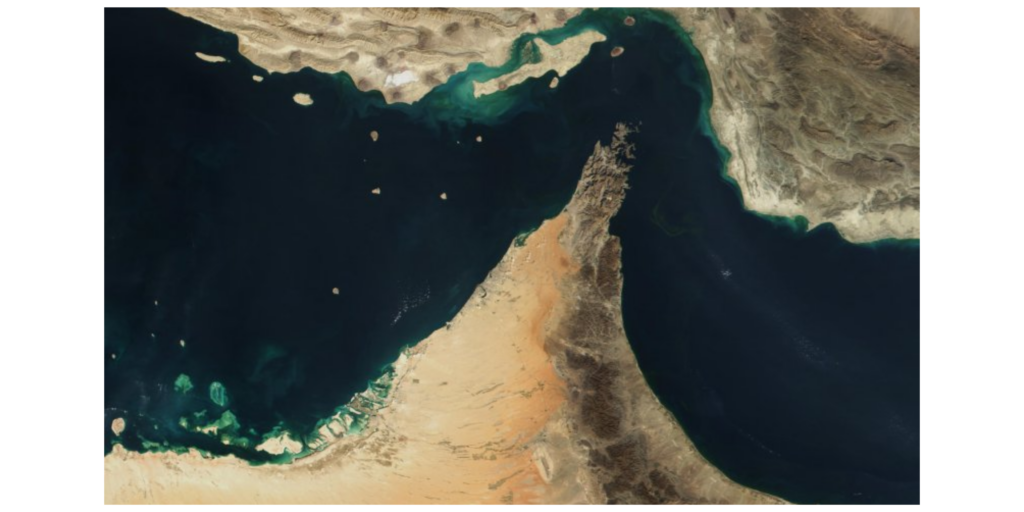
History is brutally simple: the world stands at a crossroads in the Strait of Hormuz. The choice before us is clear : settle for a temporary and costly silence, or commit to lasting global security. Between submitting to blackmail and protecting our principles, there is no middle ground.
An Umbilical Cord Weaponized
The Strait of Hormuz is not just a shipping route; it is the beating heart of the global economy. Nearly 21% of global oil consumption and 20% of LNG (Liquefied Natural Gas) trade pass through this narrow passage. Yet, this umbilical cord is now being held hostage. By militarizing this vital crossroads and turning it into a theater of terror, Iran is not just threatening ships: it is declaring open war on our collective stability.
The facts are stubborn and well-documented. Tehran is not seeking direct military confrontation; it uses the Strait as a political pressure valve. The mechanism is one of absolute cynicism: as soon as the regime feels cornered by sanctions or regional crises, it “pushes” the Hormuz button to blackmail the global economy. This “high-seas hostage-taking” strategy has been the trademark of the Islamic Revolutionary Guard Corps (IRGC) for four decades.
The world has seen this pattern repeat itself relentlessly:
-
The Hijacking of the Stena Impero (2019): In response to the impounding of one of its tankers in Gibraltar, Iran fast-roped commandos onto this British vessel. This was not a police operation, but the capture of a pawn on a global chessboard.
-
The Sabotage of the Front Altair (2019): The use of limpet mines attached below the waterline allows for striking neutral vessels without sinking them, creating just enough terror to skyrocket insurance rates and energy prices.
-
The Seizure of the Talara (2025): This latest example, under the guise of a vague judicial order, confirms that any cargo ship can be transformed into a bargaining chip overnight.
The True Cost of the “Status Quo”
Granted, Iranian threats carry significant weight: insurance premiums for ships crossing the strait have jumped by more than 60% in recent months, mechanically driving up fuel prices at the pump for the end consumer. It is an invisible tax on our daily lives. But these costs, however painful, are a pittance compared to the price we will pay tomorrow if we signal to the Tehran regime that its blackmail works.
History teaches us that whenever the international community yields to dictatorial pressure on a strategic chokepoint, aggression only increases. Ceding today in the Strait of Hormuz for the sake of short-term economic stability is to send a formal invitation to nuclear blackmail tomorrow.
Beyond the Numbers: A Question of Global Order
The current conflict is not just about the price of a barrel of crude. It is about defining who dictates the rules of the global order: the international community, as the guarantor of the right of navigation, or an “Axis of Evil” that recognizes only force and coercion.
To accept that the IRGC can arbitrarily decree the closure of a strait through simple radio messages or the seizure of commercial vessels is to renounce the freedom of the seas—a pillar of modern prosperity. We already see this model of “state-sponsored piracy” being copied by affiliated groups, such as the Houthis in the Red Sea. If impunity reigns in Hormuz, it will spread to every strait on the planet.
Conclusion: Preventing Strategic Catastrophe
Today’s economic disruptions are a necessary investment to avoid tomorrow’s strategic catastrophe. We can no longer be satisfied with precarious truces that allow the Iranian regime to rebuild its capacity for harm.
International maritime security is an indivisible public good. To guarantee it, the Iranian threat must be definitively removed from shipping lanes. Complacency is no longer an option; only firmness will ensure that the Strait of Hormuz remains what it must be: a free passage for the world, and not an instrument of terror for a desperate regime.