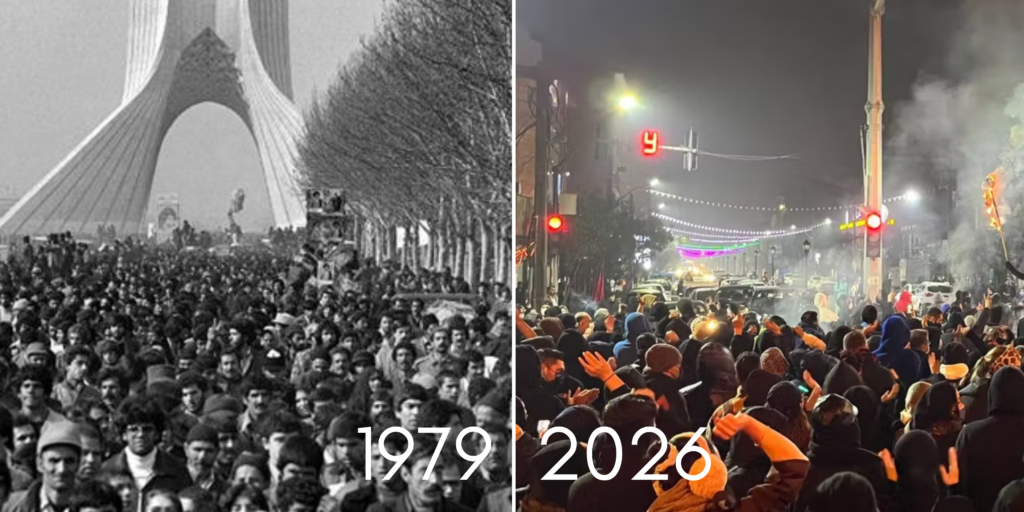
The uprisings in Iran in 1978–1979 and 2025–2026 are similar in terms of the large numbers of people demonstrating in the streets. However, these apparent similarities must be analyzed in order to fully understand the profound differences between the religious mobilization against the Shah of Iran and the secular and political movement against the Islamist regime of the mullahs.
The 1978–1979 uprising according to Foucault
Foucault’s reflections on the events in Iran between September 1978 and May 1979, in the form of passionate reports, attest to the ethnocentric blindness of the Western “left” with regard to the uprising in Iran, a blindness that continues to this day. For this reporting of ideas is symptomatic of the intellectual short-circuit caused by the projection onto Iran of the West’s own desire for revolt. The French philosopher invents proxy militancy and, by partially accepting the analysis of a small group with little influence on the actual course of events, presents their point of view as the truth of the popular movement: inspired by Shariati’s Islamo-Marxist synthesis and supported by Bazargan’s national-religious position. Foucault believes he sees Marx’s revolutionary Commune coming to fruition in Khomeini’s Iran and, without any critical distance, adopts a favorable view of the Islamic government presented by Ayatollah Shariatmadari.
A few years after the CIA-backed coup in Chile, Foucault, along with the entire anti-imperialist left, enthusiastically embraced this “barehanded revolt” by an entire people united against the over-equipped army of the Shah of Iran, whose dictatorship, both business-minded and bloodthirsty, resulted in massacres, particularly Black Friday in Jaleh Square. Celebrating Shiism as a “political and religious” force, the secular philosopher believed he saw in the masses chanting Khomeini’s name the unanimous desire for a different way of life, rooted in the Islamic tradition of Sharia law, and he presented the Ayatollah in exile near Paris as a standard-bearer without a program. Foucault refers to the mobilization apparatus constituted by sermons and cassettes circulating in the network of mosques.
But he does not seem to have understood that the revolt led by the mullahs aims to roll back the socio-economic and cultural gains of the White Revolution launched by Reza Pahlavi in 1963, given that the Shiite clergy invoked Sharia law from the outset to combat these progressive reforms, in particular women’s right to vote and the expropriation of clergy property as part of an agrarian reform undertaken at the expense of large landowners.
It is precisely this reactionary program that will be implemented by the coup d’état constitutionalizing the Islamist dictatorship of the Ayatollah (velayat-e faqih), which now has the Revolutionary Guards at its disposal to drown any protest in blood. Along with the Basij, the Pasdaran are the agents of bloody repression of the current uprising, as in 2009 and 2022 during the Women, Life, Freedom movement. In view of this criminal violence, the support given to the Islamofascist regime of the mullahs by people who call for an intifada in the streets of Paris to bring about a “revolution” in France is just as revolting as the pseudo-feminist campaigns for the right to wear the veil in Europe are indecent in view of the struggle of Iranian women against the obligation to wear the chador, and this since the demonstration on March 8, 1979, against Khomeini. For at that time, there was indeed a strong tendency toward social-revolutionary emancipation within the popular movement, which was fought by the Islamists in power and their Islamo-Marxist allies.
What about the mass uprising that is currently ongoing ?
Purpose and modality of a political movement
Similar to 1978, the revolutionary slogans of the current movement express an uncompromising rejection of the regime—Death to the dictator!—while chanting the name of an exile: Pahlavi this time, instead of Khomeini… But does this name have the same political and symbolic meaning?
In both cases, the name functions as a floating, empty signifier, which different groups fill with completely contradictory meanings, according to their beliefs and fantasies, in the sense of left-wing populism as theorized by Ernesto Laclau and Chantal Mouffe. But the big difference is that the Shiite masses associated the name Khomeini with the messianic horizon of an Islamic government governed by Sharia law, while the current generation of women and men who have experienced Islamofascist oppression firsthand are expressing their thirst for freedom at all levels of the abolition of privileges:
- economic liberalization against the regime’s predatory economy, which has caused hyperinflation that is ruining even the bazaars (markets);
- cultural emancipation from Islamist oppression in terms of traditional customs, both local and national, and the dress code fiercely imposed on women from all groups, except for the daughters of privileged dignitaries;
- freedom of moral and religious conscience, especially since many people in Iran now reject Islam;
- and finally, political freedom to choose the type of government and representatives truly elected by the people.
Syria seems to be experiencing the opposite fate: after a phase of international civil war that saw jihadist groups prevail over other opposition groups to the Baathist regime, the bloody dictatorship gave way to an Islamist regime that violently oppresses minorities in the name of Sharia law. But the end of the Islamofascist regime in Iran will not be marked by a return to monarchy. In a kind of compulsion to repeat the past, going back to resume and relaunch the revolutionary movement that had been aborted, Pahlavi has taken Khomeini’s place in the popular imagination, but this time as a transitional rallying figure rather than the object of credulous veneration.
The emergence of the people during an uprising opens up the political arena to a new system of representation, depending on the balance between two tendencies within the movement: the desire for submission to authority leads to a populist form of representation as a unified embodiment of identity that appeals to the masses to follow blindly; rejecting any delusional identification with the savior of the nation; or the desire for emancipation, which refuses any identification with a “savior of the nation,” creating instead a new pluralistic form of citizen representation.
It was in a populist and non-political manner that the popular uprising of 1978 was led and hijacked in an Islamist direction by exploiting the credulity of the Shiite masses, who needed to believe in and follow the Supreme Leader replacing the Imam! Traditionalist faith versus modernist reason. Isn’t it the opposite today?
Hardened by the painful experience they have endured for several decades, the masses of people moving through the streets of Iran, connected to the free world through the media, form a politically mature population that knows what it no longer wants.
Any mass movement certainly carries ambiguities, which in this case focus on the emblem of the solar lion associated with a proper name, but does Pahlavi refer to a politician or a dynastic regime? Nostalgia for an era of individual freedoms associated with the pre-Islamic tradition of ancient Persia carries the risk of a return to the past embodied by the unitary figure of the Shah, which royalist circles continue to cultivate.
But today, the Iranian people associate the name Pahlavi with a democratic and secular government. This change is rooted in the political experience of self-defense groups and resistance to Islamofascist oppression. There is clear evidence of this on this site :
“The streets of Iran are the scene of a completely leaderless, pluralistic, and spontaneous uprising, resulting from nearly half a century of imposed repression, economic mismanagement of resources, and systemic corruption of the mullahs’ power. […] Protesters in Tehran, Mashhad, Isfahan, Hamedan, and countless other cities, down to the smallest villages, have organized spontaneously according to local, regional, and professional logic, within family and friendship circles, without any chain of command or outside support, simultaneously leading protests in thousands of areas across the country.”
This experience of autonomy, which arises spontaneously within the revolutionary movement, is the prelude to the democratic organization of political life. The paradox is that the revolution Foucault dreamed of is coming to pass, but in a completely different form: the consensus of the Shiite masses was an expression of populist credulity, not “political spirituality.” now, the people who have risen up against clerical rule are burning mosques and Koranic schools and demanding the abolition of privileges as a prelude to socio-economic prosperity and cultural fulfillment in political institutions.
What is the one and only obstacle?
As in Syria, the violent repression of the popular movement risks provoking an international civil war, which the regime has initiated by recruiting foreign mercenaries. The presence of these jihadists from elsewhere attests to the Islamofascist regime’s inability to quell the uprising on its own, despite mass killings on a scale unmatched by the armed repression of 1978: terror and ideology. Proxy militants in the West congratulate proxy supporters in Iran who defend the mullahs’ regime with arms in hand… Under these circumstances, it is irresponsible, on both the right and the left, to criticize in advance any military intervention in support of the popular movement by raising the specter of destabilization in the Middle East, for which the West would pay the price!