Crisis in the “Leaderless Land”
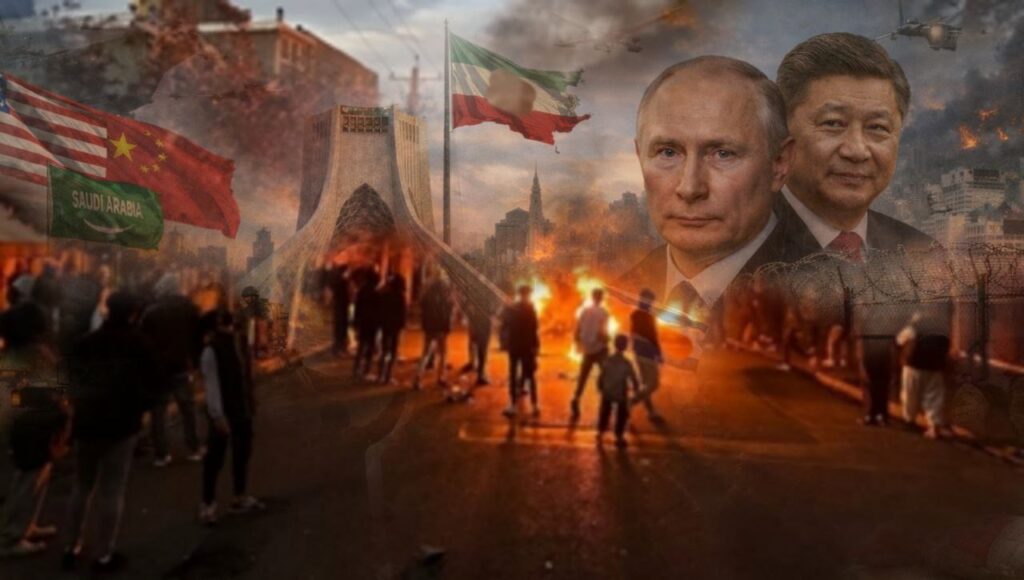
January 2026 (Dey 1404) can be considered a turning point in the contemporary history of the Middle East. The Islamic Republic of Iran, after sustaining heavy infrastructural blows in the “12-Day War” (June 2025), is now facing not a classic revolution with specific leadership, but a more complex phenomenon: “The functional collapse of the government”. Contrary to the narratives of some Persian-language media outlets abroad, deep intelligence analyses show that the streets of Iran are witnessing a completely “Leaderless”, pluralistic, and spontaneous uprising, which is the result of half a century of imposed repression, mismanagement of the economy and resources, and the systematic corruption of the mullahs’ rule.
By eliminating media noise, this analysis addresses the scene coldly and realistically: a place where the people of Iran inside [the country] are fighting for survival, and the main key to change is evaluated to be in the hands of the people inside. In this writing, we simultaneously address the positions of Iran’s neighbors (Arabs and Turks) regarding fundamental changes in Iran. Countries that, more than being eager for democracy in Iran, are terrified of the “Black Hole Scenario” (vacuum of country management resulting from revolution) and its security, economic, and other consequences.
The “Bread and Survival” Riot and the End of a Social Contract
The main driving engine in the January 2026 protests is not political ideologies, but the absolute collapse of livelihood. The US dollar, which has crossed the 1.5 million Rial mark in the unofficial market, has completely eliminated the middle class. Economic reports indicate that the I.R. has entered the “economy of survival” phase. Power cuts to industries, shortages of gas, water, and energy carriers, shortages of livestock inputs and the paralysis of basic goods production, and real inflation above 100%, have completely severed the economic relationship between the people and the government.
Unlike previous years, this time the core of the protests formed in the “Bazaar” and from the “table” [sustenance]. The Bazaar, which in central regions (especially Tehran and major cities) has been a traditional and long-standing ally of the religious government from the past until now, and had never taken the initiative to start protests against the government, today, with a complete 180-degree turn, has demanded change in the system. A demand that remained unchanged in content even with the government’s superficial and commanded lowering of the dollar price, because the Bazaaris, through their own analysis and experience, have clearly understood that the government’s economic collapse was triggered long ago and there is no way out of it. In truth, the unwritten contract of the Bazaaris with the government based on tolerance has now been terminated due to the government’s breach of promise and inability to manage inflation. The termination of a social contract that was a guarantor for the relative stability of sovereignty in Iran for half a century has confronted the regime with a major challenge from which escape is not at all easy.
Following the termination of this contract and with the presence and protest of the Bazaaris, other social strata from employees and workers and university students to school students and retirees faced a new phenomenon. Protesting Bazaaris in the street and the shared pain of all strata with the Bazaaris on one hand, and social demands and trampled human rights of citizens that had been suppressed time and again, were also added to the demands.
Protesters in the streets of Tehran, Mashhad, Isfahan, Hamedan, and… other major cities down to the smallest villages were organized spontaneously based on local, regional, and guild patterns and from among relatives and friends, and without receiving any command line or support from outside, advanced the protests simultaneously in thousands of regions of the country.
The protests were no longer limited to bread, and human dignity and freedom quickly became the main priority of the protests. Simultaneously, images were transmitted from inside Iran showing that protesters captured government-owned chain stores, but despite the very bad economic situation, they tore open bags of rice, which is the staple food of Iranians, and poured them on the ground. People did not take even a single grain of rice or other goods home to show that liberation from dictatorship and human rights are more important to them than bread and survival.
The Neighbors’ Paradox Regarding Revolution in Iran: Fear of “Somalia Next Door”
For Iran’s Arab neighbors, potential changes or the occurrence of an imminent revolution in Iran have brought about a complex situation. Qatar has always been a supporter of the Islamic Republic’s survival.
Qatar’s support for the survival of the Islamic Republic is rooted in an opportunistic strategy in which a “weak and sanctioned Iran” is much more profitable than a democratic and developed Iran. Economically, technological sanctions on Iran allow Qatar to exploit the joint South Pars gas field without a rival and at maximum capacity, while the liberation of Iran would mean the emergence of a powerful rival in the global energy market and the end of Doha’s gas monopoly.
In the political arena too, Qatar’s special status as the “sole diplomatic channel” between the West and Tehran, as well as using the Islamic Republic as a weight to balance power against Saudi Arabia’s hegemony, is only guaranteed by the continuation of the current government; (Doha believes that the presence of the Islamic Republic as a counterweight (albeit a troublesome one) prevents Saudi Arabia and the UAE from having complete hegemony over the Persian Gulf and swallowing Qatar.) Therefore, the fall of the dictatorship in Iran effectively means the loss of huge economic rents and levers of political influence for Qatar.
Saudi Arabia and the United Arab Emirates, despite longstanding hostility with Tehran, have now turned into the biggest lobbyists in Washington to prevent a violent regime change.
Mohammed bin Salman, who has tied the fate of his kingdom to the success of the “Vision 2030” project, knows well that: Capital is cowardly. Any civil war or severe instability in Iran means insecurity in the Persian Gulf, the flight of investors from projects like NEOM, and the likelihood of suicidal actions by regime remnants against oil fields. Riyadh has warned the White House in confidential messages that a “sudden collapse” in Tehran creates a power vacuum that could be filled by militia groups, drug trafficking, and a flood of refugees. For them, a weak and contained Iran (even with the current regime) is much less dangerous than a chaotic Iran.
The UAE is also involved in the “Paradox of Islands”; a double game in which on one hand it maintains pressure with banking sanctions, and on the other hand, keeps diplomatic channels open to prevent any retaliatory action by the regime against the glass infrastructures of Dubai and Abu Dhabi.
Turkey: Security Wall and the Kurdish Enigma
For Ankara, developments in Iran are not a geopolitical opportunity, but an existential security threat. With the official dissolution of the PKK in 2025, Turkey’s concern has shifted towards its eastern borders. Ankara fears that with the weakening of the central government in Iran, Kurdish groups like PJAK will take advantage of the power vacuum and turn northwestern Iran into a base for autonomy; a matter that could challenge Turkey’s internal peace achievements. Furthermore, the fear of a flood of millions of Iranian refugees has forced the Turkish army to reinforce border walls and adopt severe security measures. Hakan Fidan’s explicit opposition to foreign military intervention is rooted in this very concern: Turkey does not want to pay the human cost of Iran’s collapse. On the other hand, Turks think they should not lose an ostensibly Muslim ideological partner and enemy of Israel. Because after the collapse of the Islamic Republic’s sovereignty, the chance of establishing a secular sovereignty and Iran’s closeness to Israel and the West would be a potential threat to Turkey.
Israel and the “Octopus in a Jar” Doctrine
On the other side of the borders, Israel’s strategy regarding these developments has distanced itself from traditional paradigms. Tel Aviv, which dealt effective blows to Iran’s nuclear and defensive infrastructure in the 12-Day War, has now adopted the strategy of “watching”. The calculations of Netanyahu and his security cabinet are based on the principle that the Islamic Republic’s biggest enemy right now is the “ruined economy” and “hungry people”.
From Tel Aviv’s perspective, any direct military attack at this sensitive juncture could act as a “gift to the regime” to intensify repression from this severe level to a much more severe level under the pretext of foreign attack. The current situation of the Islamic Republic is interpreted as a state of “neither death nor life”. A situation where the energy of the terrorist IRGC and the regime’s security apparatuses is spent on containing internal crises, and their ability to feed proxy arms (Hezbollah and Hamas) reaches zero. For now, Israel prefers to be an observer and remain silent so that the “head of the octopus” is swallowed by its own body inside the jar. Meanwhile, the history of unpredictability of Israel’s moves cannot be ignored at all, but a point worth pondering is that: Israel only takes action when it achieves a very favorable and guaranteed result.
Global Players: From Indifference to Opportunism
At the macro level, the United States, with the return of Donald Trump and the “Maximum Pressure 2” policy, has harsh rhetoric but appears to currently lack a real strategy for the “day after the overthrow”. Therefore, Washington is worried about a repetition of the Libya scenario and seemingly has no desire for direct conflict on a large scale for the time being (or at least is displaying such an idea). Trump, regardless of any view, must bring along a large number of internal and external factors for any move (military attack). On the other hand, the current President of the United States insists very much on being known as an unpredictable surpriser on the global level. Therefore, it is not unlikely that the United States will surprise the world and the people of Iran with a surprise attack in the coming hours or days.
China looks at Iran merely as a “cheap gas station” and is not willing to pay a political cost to save the mullahs. China’s main interests in Iran are focused on preserving investments and its long-term commercial positions, regardless of various scenarios of Iran’s future political transformation. In the current situation where the regime’s survival has no guarantee, China has consciously chosen a “low profile” approach to maintain maximum flexibility for readjusting its position in the path of Iran’s political developments.
Russia, which is itself caught in the Ukraine quagmire, has neither the ability to help nor the desire; Moscow would not even mind if the West’s focus turned to the Iran crisis so that pressure is lifted from the Ukraine front. Russia today goes all out in appearance in supporting the Islamic Republic against the international community, only to sell the price of retreating from its current positions to the West more expensively tomorrow. This approach shows that even players who are seemingly supporters of the Islamic Republic view it not as a stable partner, but as a temporary and tradable asset.
For Russia, Iran is not an ideological ally, but a tool for bargaining, creating friction, and increasing leverage in other dossiers.